
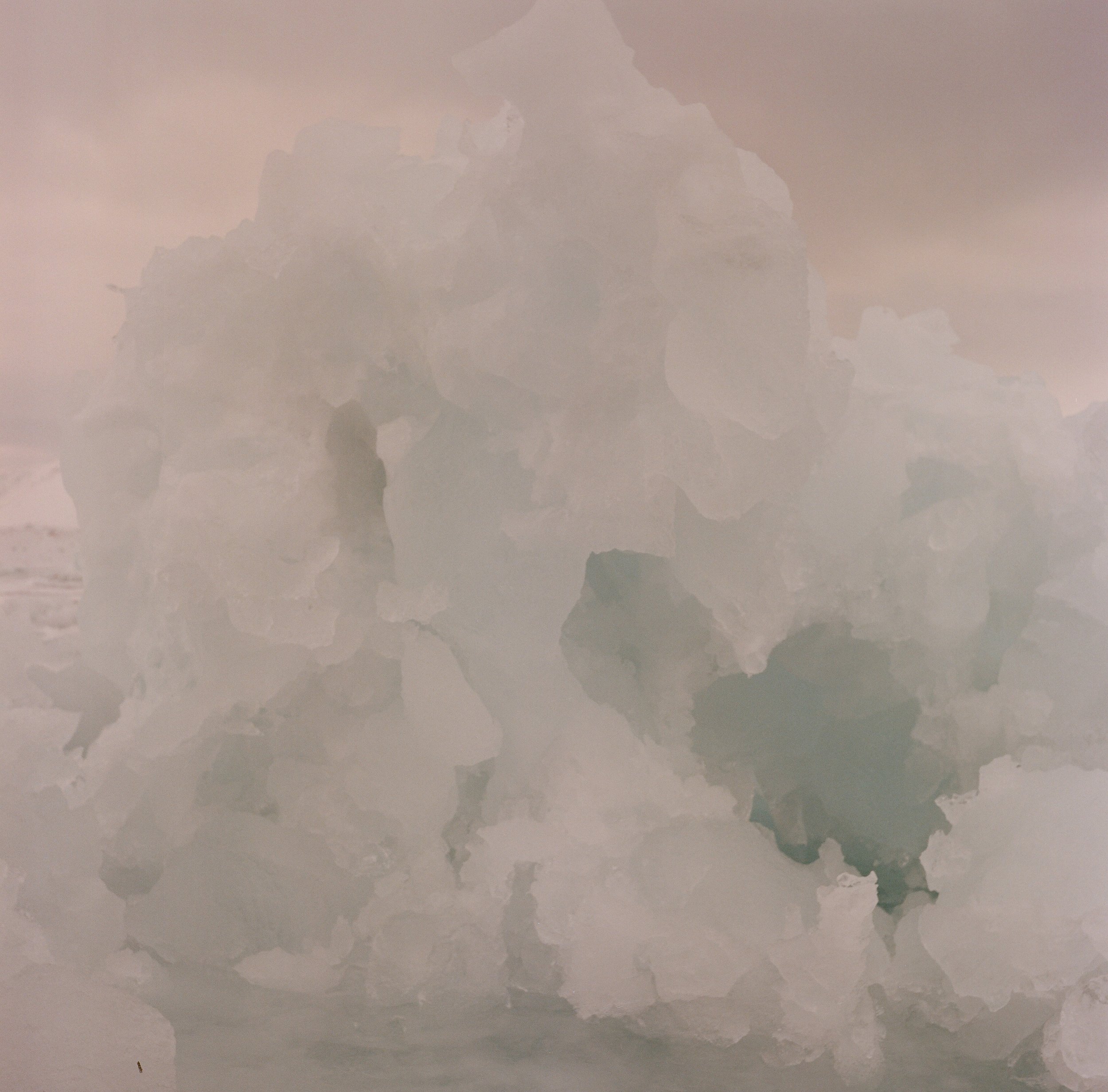
ARCTIC CIRCLE RESIDENCY
A year and a half ago, I boarded the Antigua with a group of artists, researchers, writers, and explorers for a two-week expedition through Svalbard. The Arctic Circle residency had been on my artist “bucket list” since 2015, when opportunities like this felt distant—more fantasy than possible future. It was the kind of dream many artists have: to escape daily life long enough to come back altered in ways you couldn’t predict.
When I applied, I planned to explore a thread in Mary Shelley’s Frankenstein: the relationship between mental and environmental collapse, and the structures that shape or confine self-invention. In my work, I’ve always cared more about the mechanics of seeing—the ghosts, you might say, that trap perception within narrow limits—than about what representation claims to reveal.
I wanted to make work that pursued actuality, even truth—something closer to rigorous science than the culture industry’s pathological excess. For me that meant: (1) exposing how capital shapes desire and perception; (2) asking how these patterns persist through language, practice, and politics; and (3) confronting what we repress most—our own abuse and how we’ve abused others.
In grad school, Sylvia Wynter became indispensable. Her writing on how language overdetermines perception—how the “inner eyes” through which we encounter reality are shaped by the bioeconomic figure of “Man”—helped me articulate intuitions I’d carried for years. She showed how language mutates while the structures that validate white supremacy persist, limiting imagination, belief, and action. Violence, reproduced and concealed through language and social systems, became central to my thinking.
Critique of these systems infused many conversations I had as an artist, but I grew frustrated by the absence of exit routes. For many artists, the game was to get the show, be represented. The terminology itself exposed the trap. I couldn’t reconcile how American ideals of spiritual, scientific, and artistic “exploration,” ostensibly in service of progress and freedom, were made visible only through wealth generated by normalized rituals of violence. There was a kind of resignation—the belief that the best we could do was shine a light on oppression and somehow convert it into meaning.
Trying to become an artist in New York throughout my twenties and thirties, self-making was painful and destabilizing. The art world’s idea of “success” didn’t align with the critical vocabulary I was developing, or lived experience. What was framed as fighting for relevance, or for a “voice,” was in reality fighting for your life—or chasing the right to maintain that illusion in the company of others.
Living in the city often felt like drifting on an inflatable raft with a slow leak: every breath devoted to staying afloat. I wanted to believe things would eventually ease, yet I carried a deep insecurity that without economic stability, I would never be respected, or even “fully” a man. Every choice passed through the tension of wanting safety and wanting to rupture the dynamics that made safety feel impossible. My mental health was often precarious. The strain pushed me toward self-neglect or self-destruction—the pleasure of degradation sometimes easier than the pain of hope.
Alongside making art, falling in love, and embodying the roles that kept me afloat, I spent years reading (often at work), walking, and daydreaming—what I didn’t yet know to call research. I oscillated between periods of work and unemployment. I craved the ability to slow time and think. Meanwhile, artists around me and the city itself seemed to accelerate. Drawn instinctively toward psychoanalysis, I turned scrutiny inward, studying the mental and biological prisons that shadowed me despite my desire to transform. I spent years digging into the foundations of my hometown with an ethnographic impulse, recognizing the camera lens and the mining shaft as twin metaphors for the drive to possess, dominate, and define.
I circled the idea of “home as foreign”—a history unacknowledged, making humanity or selfhood permanently elusive. My mind often returned to the monster’s fate in Frankenstein after he sees his reflection. I suspected his pain came from the convergence of a buried past and an inevitable catastrophe. Reconciliation at the edge of “progress” is something people intuitively know is impossible. Culture, I thought, is residue—a map of our attempts to find our way home in the land of dispossession.
My last two years in New York taught me how little power we have in shaping ourselves. Just as I finished building out my loft—a vanity project a decade in the making—my ex-girlfriend Eliza became gravely ill and lost control of her body. The hospital became a second home for nearly a year. In that powerlessness, my ideas of strength, love, weakness, and sacrifice were radically tested and recalibrated. The pandemic cracked the world open shortly after, revealing both a necessity and an opportunity to transform myself.
CalArts sold crisis as opportunity—seductive to artists who secretly fetishize being self-made. When I met Laura, we walked through one of Do Ho Suh’s translucent home sculptures on interview day—the first official day of the pandemic. We shared a romantic idea of Los Angeles as the backdrop for a life we could finally claim as our own. I loved the way she talked about her work, and our shared belief that art wasn’t confined to the usual categories—it was an unregulated force. I imagined our path forward together as allies.
Packing my car and driving to California in 2020—after nearly two decades in New York—was the first time the world matched my own fragmentation and estrangement. But there was optimism too. The global crisis unfolding in real time was undeniable proof that another force could interrupt the logic of Western Civilization.
When I arrived in Los Angeles, the air was opaque with smoke. You could see the gray haze from New Mexico. I thought: I am driving straight into the abyss.
I arrived broke in every sense, but Laura let me believe otherwise. We had both run from where we came from and collided, hard, into each other’s arms, imagining the other as a kind of rescuer. She accepted me without judgment, reminding me I had “what I needed.” She made me feel admired—revered, even—and deeply loved. We married quickly, ignoring the risks, fueled by something close to supernatural attraction. The practical and emotional challenges ahead were obscured by our dedication to our work and school, surrounded by peers and big questions that gave our lives direction.
Questions I’d long wrestled with as an artist—and ones sharpened by Eliza’s illness—about power, freedom, agency, and institutionalization became daily topics. I couldn’t understand the call to “return to normal.” I didn’t know what version of normal was supposed to be acceptable. What I did know was that art had to be more than a hustle, entrepreneurial ambition, or the conversion of pain into commodity within a system that insists “work will set you free.”
Seventeen years in New York taught me to stretch my skills, wit, sexuality, time, and body into a form of currency that could pay for my survival and open doors. I was depleted from the constant performance—marketing myself, hustling, improvising, and finding a hack just to stay afloat. I wasn’t eager to relive those traumas in Los Angeles. But the pressure to perform seeped into everything—including relationships—to the point where you bury your struggles deep. The world continued to crack open, but we were expected to carry on, with no time to grieve.
Laura and I supported each other as best we could. Behind the scenes, we buckled under the weight of the present and each other’s histories. Writing connected us through the murk. We treated our relationship like a love story we could write in real time, ignoring conventions and rules to keep it alive. Even with a shared language, we suffered differently, trying to realize ourselves within the story we were building. After repeated failures to secure teaching work and a lack of community support, I lost confidence that LA would offer more than New York—or that the art world could change at all.
I reverted to old survival skills, throwing every mental, physical, and financial resource I had (or didn’t) into earning the life I wanted and appearing “put together.” I built out another space downtown with almost no help. The past resurfaced through old coping strategies, addictions, and fears I couldn’t suppress. At one point, I began to self-harm, and I knew I’d lose Laura if I didn’t prioritize my mental health over an art career. I no longer knew what I was even working toward.
Often only our love held us together. But in the months leading to my departure, with a lot of work, we found a fragile calm. I received a diagnosis and a medication regimen that helped. Weed became a dominant feature of my life—a half-solution, or a “hack” for the rough edges. We built a community and started an art gallery. Confidence returned, and with it gratitude that we had survived intact.
I gradually accepted that I didn’t need to be an ideal husband, artist, man, or father—or everything Laura needed. When I forgave myself for failing my own imagined ideals, I felt proud of the scars that earned me this perspective and vocabulary.
Community in LA remained elusive. The confidence to challenge entrenched systems of power evaporates quickly as artists scramble to live, work, and find time to make art—hungry for a miraculous break. These pressures often drive wedges between artists as well. But in early 2024, I was heartened to see our community engage politics, stand in solidarity with Palestinians, and defy the narratives imposed by institutional pressures. By then, the romantic image of LA had given way to a tragicomic awe at its harshness—a salvage yard of social systems, inadequate infrastructure, severe inequality, short-term relationships, and precarious work. What gave life shape here—everywhere, but especially here—was the product of human labor, fragile contracts, and commitments between people. Love.
I eventually saw that all the noise had kept me from enjoying the everyday signs that I was seen and loved: breakfast together, feeding the cats, watching them stalk squirrels through the window, having friends over for dinner. These small rituals were the result of sacrifice; maintaining them felt like work that belonged to me. Months before the residency, we moved into the last home we would share—a Hollywood-style apartment near Runyon Canyon. We found a routine, and I began to feel I had finally earned the life I wanted. Being with Laura felt like the fulfillment of the dream I’d carried when leaving New York: to commit more fully to my work and take better care of myself.
Before flying out, I stopped in New Jersey to pick up a family heirloom—my grandmother’s wedding ring. Even though we were already married, I intended to propose intentionally when I returned. I wanted the ring to mark the quiet work and trust we’d built over two hard years—a recommitment. I packed the ring with my Arctic gear—merino wool, muck boots, a new North Face, and a few tools for my work. Like moving to California in 2020, I imagined the residency marking a new threshold. It felt like our story was still being written out of order.
I arrived in Svalbard with no grand plan. My supplies were minimal: a remarkable sketchbook and a camera I borrowed from Laura. I didn’t want to “capture” the place strategically—only to take notes, sketch, gather fragments, clips of video, sensations, light, and everyday encounters.
I suspected the place would change me more than I could shape it. Yet arriving somewhere impossibly remote and claiming speechlessness felt cliché—a way to avoid action. Still, Svalbard shut down language in a material way. It felt like landing on another planet and descending into a deep interior simultaneously. We set to work immediately, but trying to grasp anything felt futile, even silly. Residents took photos, recorded underwater, flew drones, drew, collected fragments. Data. Flavors. Salt. Every detail.
The first time we moored to the ice, I woke to frantic footsteps outside my cabin. Our guides—artists themselves—set up a large perimeter with rifles for polar bear safety. When I stepped outside and saw our group scattered across the white desert, everyone appeared childlike and out of place. There was comfort in that shared precarity, in the fact that none of us looked like we belonged. We were surrounded by the immensity of everything beyond our control—no cell service, no familiar landmarks, no sunset for almost two weeks.
After a rocky start, I acclimated quickly to life on the Antigua. Even with few chances to go ashore, I didn’t want to disembark—not out of fear or comfort, but because I was fascinated, growing attached to every detail of the ship and the lives aboard it.
Whenever we landed, I’d look back at the Antigua—still imposing against the endless sky and ice. Standing on deck, I studied the twisted rigging that held the ship together. I thought about the dialectic between freedom and bondage. The vessel became a metaphor—and demonstration—of the delicate agreements between people and things. Every space was intentional. Every fiber carried the logic and legacies of colonialism: its materials, navigation, European flags, the “exotic” female figure at the helm. Rigid and adaptive, it was held together by tension and noise. People made it work. So many ideals were bound up in this imperfect vessel that kept us alive in a hostile environment, and allowed for a feeling of safety in an unstable world.
Evenings were for presentations. One writer in our group read about fear and finality in the terrain—the false safety that accompanied us on our journey. We want to believe we’re in good hands, that we belong, that we’re part of something bigger—an expedition, a family, a nation, an exploration backed by authority and progress.
The vastness made you feel like a speck, but it also amplified what you carried with you. Memories returned sharply: winters from childhood, nights in the hospital, hugging my mom as I left for California, sleeping in my trailer with Laura, and the things we survived in LA. Something in the air suggested we were all desperate for hope in the world we’d soon return to, and our shared vulnerability in the Arctic made that desperation sharpen.
Our days formed around meals, landings, long conversations, and the relentless awe of the landscape and each other. Without phones, something immediate and necessary emerged. You could feel the early formation of friendships. At times it felt like a reunion, as if I’d known these people before. The camaraderie felt real—something I’d only briefly experienced in grad school and had missed in LA.
With one resident, Ola, something deeper formed—romantic in ways I hadn’t anticipated. What began as shared laughter and proximity became care. I admitted I liked her more than I should; she felt the same. Hugs grew more frequent. I convinced myself it was innocent, that staying within an imaginary boundary meant it wasn’t betrayal. But even this was enough to break trust. Soon, it was undeniable.
When Ola looked at me, I saw love in her eyes. I feared that looking back too long would reveal mine. I felt held in a way I didn’t know I needed. Yet I never imagined a life without Laura. I tried to hold onto our love, the identity I’d built in LA, and the ring hidden in my luggage. Even as I flew away from Norway, I believed we were strong enough to survive another tremor. I wanted to come clean, and continued to hold onto hope—I couldn’t yet see that what Laura and I had built was beyond repair.
Returning to the U.S., I felt the country pressing down. Anger, scarcity, survival—everything felt abrasive. Coming down from the residency, the contrast sharpened my dread. Everyone’s time felt claimed; mine felt borrowed. My legs wobbled for days; even my Red Wings felt foreign—or maybe my body was bracing for another blow.
I took the ferry carrying the ring and the camera, photographing lower Manhattan from the pier where we’d launched our wedding celebration two years earlier. The first year had been hard, the second easier, and now this. The skyscrapers reflected like glacier towers—structures rising out of the water instead of eroding into it piece by piece.
I revisited the sites of that pact, the places we walked, feeling caught on the far side of my former life’s reflection. I still believed I could fix it, that our love’s strength would be visible, legible, enough. That everything we’d survived—and everything we’d built in LA—would matter.
Laura had every reason to leave, and she did. What I wasn’t prepared for was the retaliation—the cruelty, the public dissection, the pleasure she seemed to take in dismantling my character. She constructed a narrative I couldn’t escape—one that has shaken my foundation ever since. I became a cartoonish toxic male cliché. My history was pathologized. My failure to control my connection with Ola wasn’t a single breach; to her, it confirmed everything she already believed. It was maddening to lose agency over my own life, to have no control over my own story. Worse was the narrative that my failure as a man meant I deserved every loss consuming my sense of safety.
I didn’t see Laura for months, and when I finally did, she was visibly worn down. My instinct was to care for her, feed her, embrace her. Our communication had been mostly through text or tense phone calls that ended in anger. Language now divided us. When I was allowed back into the apartment to gather a few things, the truth was unmistakable. I felt like a ghost haunting a life that might never have been mine.
It became harder to face the real reckoning: the life I fought to deserve—the artist, the man, the partner, the community member—had collapsed. The will to shape a narrative of resilience collapsed too. I fought to believe instability was forging the artist I was meant to become, but that dream had become performance—compensation for the fear of not being enough. This was the breaking point of a life shaped by survival and the desire to be worthy. I stopped working entirely. I leaned into addictions. I lived in my car for months, like so many others.
Back in LA, I walked for hours and smoked weed to cope. Being high kept me present instead of spiraling into past or future. It became, strangely, a spiritual practice—an opening into imagination, into connection without restraint. I rode the train across LA, talked to strangers, joined reading groups. I witnessed the daily violences and the daily acts of love that keep the place alive. I began to write.
This past year has been the slow realization that the life I was building before the residency—the artist and man I thought I was becoming—no longer belonged to me. Perhaps it never did. The Arctic didn’t cause the collapse; it marked it. Everything held by a thread—relationships, mental health, work, self-image—finally snapped. Things I hadn’t named surfaced. Patterns I thought I’d outrun returned sharper and more authoritative. The scaffolding holding up all my big promises crumbled.
I’d spent my whole life trying to build my idea of “home”—a place from which living could finally begin. The task was incomplete. I pursued home in my work because I experienced it mostly as an absence—images, smells, figures drifting in and out without ceremony. I didn’t know where I belonged, or whether perpetual motion was simply my condition. Losing family, pets, friends—daily reminders of being seen and being human—made me sharply aware of what I carried. I became aware of what the body demands, and how the structures supposedly built to meet those demands are not a given.
Beyond the basic needs, I felt the necessity of living at odds with the roles and narratives that discipline us. There was a strange, maddening freedom in that. A kind I’d never felt. I realized I could live without the usual comforts, and that life would take on a shape I couldn’t predict. Mostly there was a quiet sense that, after everything, I was still here. I was grateful to be alive.
I finally understood something Laura tried to teach me early on: I have what I need. Just me. I shouldn’t fear lack—as an artist or a man—or believe I deserved every loss that eroded my safety. I was grateful for what remained: my values, my ability to find meaning in the mundane—the labor of cleaning, building, organizing, collecting, breaking down, reassembling. Working with my hands. Letting interruptions open questions. Cutting through banality with humor. Investigation, intoxication, love, grief—they continue to fuel me, and they form a knowledge I carry.
But none of this implies a clean arc. There is no transformation without acknowledging the harm I caused. I’m still reckoning with a long history of self-destruction, mental illness, and the painful truth that these parts of me kept me from caring for Laura in the ways I promised and she deserved. I’m still tangled in the unraveling, confronting the gap between who I hoped to be and the internal and external forces that blocked that path.
My fortieth year arrived with brutal clarity. Sadness, rage, yes—but also wonder, discovery, gratitude. Individual lives—people and animals—gave me places to crash, fed me, played with me, showed care. Family and friends helped restore parts of me I needed to rebuild. Former mentors helped me imagine a different direction as an artist—one that might restore my passion for new possibilities between theory and practice.
I made a leap into art direction and found, surprisingly, that I enjoy it. Even if it isn’t permanent, the chance to do that work in LA stands out amid the wreckage. One of my biggest fears—ironically tied to not being “enough”—was ending up isolated like the monster at the end of Frankenstein: dead inside the world of the living, or rearranged to fit a story I didn’t write.
Whatever the larger pattern, I know long, slow, uncomfortable work lies ahead. Some days I still feel mid–free fall, still unraveling the questions and pain of the past year and a half. I don’t want to rush meaning or pretend I’m further along than I am. This isn’t clarity, nor a romantic portrayal of struggle—it’s the sediment of a year spent searching for words to describe what remains. A desire to take agency over my story.
I’ve learned from watching my life change without permission—years spent trying to shape a life, only to realize I’d been shaped by it instead. After the divorce, I spent a year battling myself, trying to rebuild momentum in LA. It felt arduous, unsupported, nearly impossible. I know this pain is familiar to many artists, yet I keep asking: What role can artists play in supporting one another in a world designed to be painful? If freedom is essential to making art, why do artists have so little influence over the structures that limit it? When do we finally say “enough pain” instead of continuing to deliver what the customer demands?
I don’t have answers. I don’t even know what story I’m in now—or whether there is one. There was no homecoming. Just something else—a drift I’m still inside. I’ve grown accustomed to living on borrowed time, most at home in motion. Maybe that’s why I’ve embraced instability at every turning point: to see what remains after the familiar parts fall away. I’m still trying to figure out what matters, what survives, and what remains mine when everything anchoring me disappears.
I’m not good at endings, and this reflection doesn’t demand one. To call any of this transformative would suggest a clean before and after—and this wasn’t that. Returning was more humbling and disorienting than anything I experienced in the Arctic. I haven’t found my footing. Writing this was necessary, but it isn’t triumph. I haven’t had stable housing since coming back to the U.S., and that alone has pushed me to widen my horizons. Right now, leaving LA to be closer to family and friends on the East Coast feels right. From there, I’ll continue pursuing teaching—a genuine passion—and take on production work when I can. Beyond that, I plan to return to school, continue my research, and work toward building the art world I want to see.
